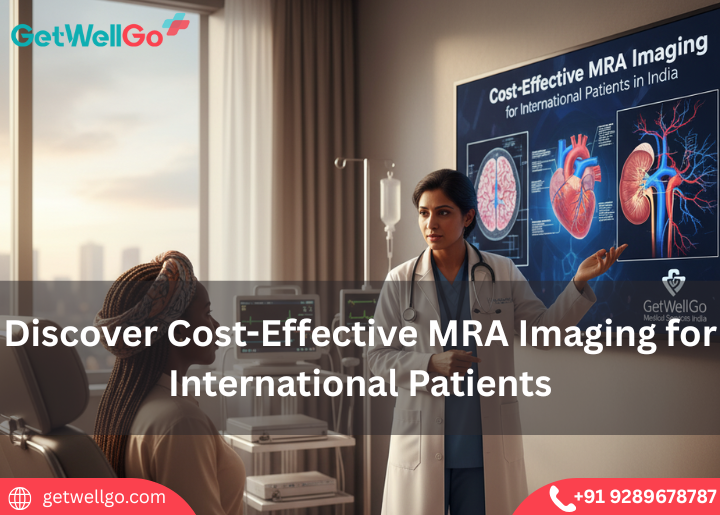
Discover Cost-Effective MRA Imaging for International Patients
Explore cost-effective MRA imaging abroad with GetWellGo. Trusted by international patients for quality diagnostics, accessible care, and peace of mind.
Magnetic Resonance Angiography (MRA) is an imaging modality, based on magnetic resonance imaging (MRI) that is a non-invasive method to visualize blood vessels, which does not require conventional catheter angiography. It assists in the detection of abnormalities of the arteries and veins in the body.
How it Works?
Application: This is done using a powerful magnetic field, radio waves and occasionally a contrast agent (gadolinium) to create detailed pictures of the vessel.
It does not involve the use of ionizing radiation unlike CT angiography (CTA).
Able to produce 2D and 3D images of blood vessels.
Indications (Uses of MRA)
MRA is normally used to assess:
Brain and Neck: Aneurysms, stenosis (narrowing), stroke, disease of the carotid artery.
Heart/Aorta: Aortic aneurysms, dissections, and congenital.
Renal Arteries: Renal artery stenosis (characteristic of hypertension).
Peripheral Arteries: The leg or arm peripheral arterial disease (PAD).
Pulmonary Arteries: Pulmonary embolism (blood clot in the arteries).
Types of MRA
Time-of-Flight (TOF) MRA, Non-contrast technique, ideal on brain vessels.
Phase Contrast (PC) MRA- Measures flow velocity, applicable to cerebral spinal flow or vascular flow.
Contrast-Enhanced MRA (CE-MRA) - Involves the use of gadolinium contrast and gives more vivid and expedited images.
MRA scan
A MRA (Magnetic Resonance Angiography) scan is a specialized form of MRI scan that targets blood vessels (arteries and veins). It forms images of blood circulation within the body in minute details to identify blockages, narrowing, clots, aneurysms or malformation.
How the Scan is Done?
Preparation
You can be told not to eat/drink a few hours (when contrast is applied).
Metal objects (jewels, watches, hearing aids, belts) should be taken off.
Certain patients can receive a contrast injection (gadolinium) to have a better image.
During the Scan
You are lying on a table, which moves into a huge MRI tube (tunnel-like equipment).
The scan takes between 30-90 minutes, which varies with the part of the body being scanned.
The machine sounds like a lot of banging, therefore earplugs/headphones are provided.
You have to keep quite still, so as not to see smeary pictures.
After the Scan
You may generally get home after the scan.
In case of contrast, drink water to aid in removing it in your system.
Images will be analyzed by a radiologist and will be sent to your doctor.
MRA test
A special form of MRI test called the MRA test (Magnetic Resonance Angiography test) is one that concentrates on the blood vessels. Rather than merely displaying organs and tissues, it emphasizes on the arteries and veins to determine whether blood flows at a normal rate or not.
Why is it Done?
An MRA test is recommended to doctors because of the following reasons:
Identify aneurysms (protrusion of a blood vessel).
Discover constriction or obstructions in arteries (e.g., carotid in the neck, coronary, renal).
Discover blood clots or pulmonary embolism.
Seek vascular malformations (improper connections of the vessels).
Supervise aortic aneurysm or dissection.
Assess peripheral artery disease (PAD) of the legs or arms.
MRA brain scan
One of the specialized MRI tests that are done to the brain and the neck is a Magnetic Resonance Angiography (MRA). It aids physicians in visualising blood circulation in the arteries and veins, without the use of invasive catheter angiography.
Why is it Done?
An MRA brain scan is ordered by the doctors to:
Identify brain aneurysms (weak spots that have been filled with blood).
Identify a constriction of arteries (stenosis), which may result in stroke.
Evaluate the presence of an arteriovenous malformation (AVM) or other vascular malformation.
In patients that have had a stroke or TIA (mini-stroke), look at blood clotting or low blood flow.
Be aware of known vascular conditions of the brain.
Assess carotid or vertebral arteries of the neck, which is the blood that feeds the brain.
How the Scan is Done?
Preparation
None of significant limitations; at times fasting in case of contrast.
Take off all pieces of metal (jewellery, clips, hearing aids).
Change into a gown if needed.
During the Scan
You are on a table, which enters the MRI scanner.
The average scan time is 30 to 60 minutes.
One can hear loud knocking (earplugs/headphones are given).
You have to keep still being able to get clear pictures.
A contrast injection (gadolinium) is sometimes employed in order to have better vessel information.
After the Scan
Even normal activities can be resumed immediately.
In case of contrast, drink liquids so as to clean it out.
A radiologist will be used to scan the brain vessels and report to your doctor.
MRA heart imaging
A special form of MRI scan that is centered on the blood vessels and chambers of the heart is known as Magnetic Resonance Angiography (MRA) of the heart. It creates detailed 3D images of coronary arteries, great vessels (such as the aorta and pulmonary arteries) and blood flow patterns - without the use of X-rays.
Why is it Done?
The cardiac MRA is prescribed by doctors to:
Identify coronary artery disease (CAD) (narrowing or blockages in heart arteries).
Measure aortic aneurysms or aortic dissections.
Assess congenital heart defects (abnormal heart structure at birth).
Examine pulmonary arteries (checking clots).
Research heart muscle damage following heart attack.
Check heart muscle diseases (monitor).
Directions regarding surgery of the heart or stents.
How the Test is Done?
Preparation
No/or few food/drink restrictions typically except when to do contrast.
Take away all metal (jewellery, belts, etc.).
Synchronous imaging with heartbeat may be achieved by attaching ECG leads.
During the Scan
You are lying on a table that is moved into the scanner in the MRI.
The scan lasts 30–90 minutes.
Rough knocking noises → earplugs/headphones are supplied.
A contrast injection (gadolinium) is sometimes administered to provide better images of the vessels.
It might require you to hold your breath several seconds when taking an image.
After the Scan
You will be able to resume regular routines.
Consume liquids when contrast was applied.
The results are reviewed by a radiologist and cardiologist.
Factors Affecting MRA scan cost in India
Those factors are among the most important that determine the cost of an MRA (Magnetic Resonance Angiography) scan in India:
Type of MRA / Body Part Scanned
The processes of scanning the brain, neck, heart, aorta, abdomen and so on are not equally complex. Angiograms of the heart/whole-body are more elaborate → require more time, special protocols.
Should contrast (dye) be needed (to emphasize vessels), it is expensive.
MRI Machine / Magnet Strength / Technology
Greater Tesla strength (e.g. 3 Tesla) = increased resolution + quicker imaging, however, more expensive.
When there is state of the art software, improved coils, image reconstruction, etc. then it is more expensive.
Type and Reputation of Centre / Hospital
Higher fees are charged by private hospitals / high-end diagnostic centres.
Government hospitals or non-profit making diagnostic centres are frequently less expensive.
Price is also added to by reputation of radiologist and image interpretation.
Location / Locality / City Tier
The rates in Metro cities (Delhi, Mumbai, Bengaluru, Chennai) are generally higher in premium/locality centres.
The cheaper rates are in smaller cities, or suburbs.
The rental fee, labour, electricity, maintenance cost also differs according to location.
Use of Contrast Agent
This is more expensive should contrast be necessary (typically gadolinium in angiography).
The dose/amount of the required contrast, the type of contrast, etc., also comes in.
Urgency & Waiting Time
Centres can charge a premium in case the scan/report is required urgently or during off-hours (night, weekends).
Same day reporting compared to normal schedule can be expensive.
Additional Services
Sedation (in case patient is unable to remain motionless), special protocols (cardiac gating, breath-holding), additional imaging sequences, post-processing.
Electronic ditties, CDs/DVDs, movies.
Senior radiologist interpretation fee.
Operating Costs and Regulatory/Accreditation Costs
Accredited centres (NABH, NABL etc.) are more likely to keep the standards higher, thus can be costlier.
Maintenance of equipment, power, cooling (MRI machines need very effective cooling), and annual maintenance contracts (AMCs) increase the fixed costs.
Best hospitals for MRA scan
Artemis Hospitals, Gurgaon
Medanta-The Medicity, Gurgaon
Fortis Memorial Research Institute, Gurgaon
Max Hospital, Saket
MRA imaging in India with GetWellGo
GetWellGo is regarded as a leading supplier of healthcare services. We help our foreign clients choose the best treatment locations that suit their needs both financially and medically.
We offer:
Complete transparency
Fair costs.
24 hour availability.
Medical E-visas
Online consultation from recognized Indian experts.
Assistance in selecting India's top hospitals for MRA imaging.
Expert doctor with a strong track record of success
Assistance during and after the course of treatment.
Language Support
Travel and Accommodation Services
Case manager assigned to every patient to provide seamless support in and out of the hospital like appointment booking
Restore safe brain blood flow with Carotid Artery Stenting in India organized smoothly by our team, from rapid specialist booking to a cozy recovery stay.
Experience advanced Venaseal for Varicose Veins in India to seal damaged veins with medical glue, fully managed by our fast-track medical visa travel team.
Protect failing heart function with Impella Heart Pump Support in India organized smoothly by our team, from emergency hospital booking to a safe recovery.
Aortic Aneurysm Repair in India: Fix weak artery walls safely before they rupture. We connect you to elite vascular teams, handle fast visas & a quiet stay.
Bio-resorbable Vascular Scaffolds in India: Open your arteries with a stent that melts away naturally! We arrange top cardiologists, visas & a cozy stay.
Shockwave Lithotripsy for Arteries in India: Clear hard calcium gently with sonic waves! We arrange your top cardiologist, medical visa & a cozy recovery stay.
Explore safe, minimally invasive mitral valve repair in India for global patients with expert care, modern hospitals, and cost-effective treatment options.
Choose GetWellGo for Transcatheter Aortic Valve Replacement in India. International patients receive expert cardiac care, modern hospitals, and cost savings.
Choose GetWellGo for pediatric cardiac catheterization in India. International patients get advanced care, skilled pediatric cardiologists, and cost-effective treatment.
MitraClip Procedure in India fixes leaky heart valves without open surgery. GetWellGo handles your top cardiac clinic, medical visa, and safe recovery.
Endovascular Aneurysm Repair in India saves lives without major open surgery. GetWellGo handles your top vascular clinic bookings, visas, and safe recovery.
Get world-class varicose veins laser treatment in India at competitive costs, combining advanced technology, quick recovery options, and smooth travel support for global patients.

.png)