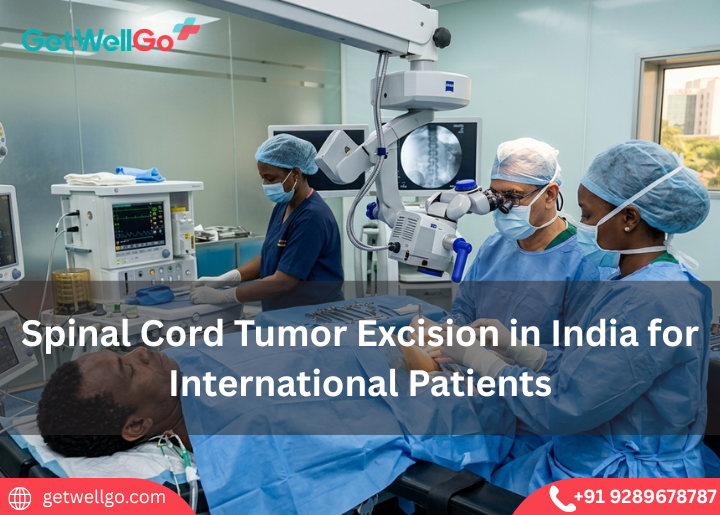
Spinal Cord Tumor Excision in India for International Patients
Experience a precise Spinal Cord Tumor Excision in India to safely remove complex growths and protect nerve function, fully supported by our medical visa team.
A spinal cord tumour is an abnormal growth found within the spinal canal or in the bones of the spine. These tumors can be benign or malignant and may press on the spinal cord or nerve roots, leading to neurological symptoms.
Spinal cord tumors are classified into:
Intramedullary tumours: inside the spinal cord
Intradural extramedullary tumors: Tumors within the dura but not within the spinal cord such as meningiomas, schwannomas.
Extradural tumors – outside the dura usually metastatic to the vertebrae.
When to do spinal cord tumor excision?
Tumor excision (surgery) is usually advised if:
Gradual loss of strength in arms or legs
Chronic pain in the neck or back
Tingling or numbness sensations
Trouble walking or standing
Inability to control bowel or bladder movements.
MRI shows that a tumour is causing compression of the spinal cord.
Tumor is growing or may be cancerous
The diagnosis must be confirmed by tissue (biopsy) diagnosis.
The advantages of surgery to remove a spinal cord tumor
Easing symptoms of spinal cord compression
Improvement in pain
Maintaining or enhancing neurological function.
Better mobility
Prevention of permanent paralysis
Correct diagnosis via examination of tissue
Improved quality of life
Factors Affecting Spinal cord tumor surgery cost India
The cost of spinal cord surgery for tumor in India varies depending on a number of factors:
The type and location of the tumour
Depending on where the tumor is located in or around the spinal cord, the surgery can be a very complex procedure. Intramedullary tumours (in the spinal cord) are usually very difficult to remove compared to extramedullary tumours, and may require the use of more advanced microsurgical techniques and longer operating time.
The size and complexity of the tumor
If the tumour is large or involves important nerves or blood vessels, or several levels of the spine, the surgery will be more complex and will take longer, using more resources, and will be more expensive.
Surgeon's Expertise
Neurosurgeons and spine surgeons who have a high level of experience as well as expertise in spinal oncology may require more professional fees. In many cases, however, their experience helps them to cut more precisely and make more successful surgical decisions.
Hospital infrastructure and accreditation
The hospital also has the ability to charge different amounts for treatment depending on the facilities, accreditation and technology available. Hospitals with specialty units for neuro-oncology, advanced operating rooms and intensive care units may charge more.
Surgical Technology Used
The application of complex technologies like neuronavigation, operating microscopes, intraoperative neurophysiological monitoring (IONM) and minimally invasive surgery, can increase the total expenditure but can also be helpful to improve the safety and accuracy of surgery.
Diagnostic Tests and Preoperative Evaluation
The full cost of treatment includes thorough diagnostic testing such as MRI, CT scans, blood tests, cardiac evaluation, anaesthetic assessment and specialized imaging.
The type of surgical procedure
Final cost depends on the complexity of the surgical procedure like laminectomy, laminoplasty, minimally invasive tumor removal surgery and spinal stabilization by instrumentation.
Spinal reconstruction or implants
When a tumor is removed, the stability of the spine is sometimes affected, which lead to a higher cost for additional treatment options, such as spinal fusion or insertion of rods, screws, cages or other implants.
The duration of hospital stay
The cost of the hospital stay will be higher for patients who need extended hospitalization or intensive care monitoring or further hospital observation after surgery, than for those who don't need such monitoring or observation.
Postoperative Rehabilitation
Aftercare services such as physical therapy, occupational therapy, neurological rehabilitation, pain management and follow-up consultations are also vital to recovery and a contributing factor to the cost.
Histopathology and Additional Cancer Treatment
After the tumor is removed the tissue is examined to find out the type of tumor. A few patients may need additional treatment like radiotherapy, chemotherapy or targeted therapy based on the pathological findings and that will contribute for the overall treatment cost.
International Patient Services
For the patients visiting from abroad, there are other charges like medical visa assistance, airport transfer, interpreter services, stay and travel arrangements which could also impact on the total treatment cost in India.
Best hospitals for spinal cord tumor surgery in India
Spinal tumor treatment in India involves cutting-edge diagnostics, expert neurosurgical care and a multidisciplinary approach to cancer management addressing both benign and malignant spinal tumors and the spinal cord.
Treatment Options for Spinal Tumors:
Resection of tumor by surgery
Surgery is usually the first treatment for spinal tumours which are pressing on the spinal cord or nerves. Neurosurgeons employ microsurgical techniques, high power operating microscopes, neuronavigation and IONM to safely remove the tumor with the least amount of injury to surrounding tissues.
Minimally Invasive Spine Surgery
In certain cases, tumor removal can be performed using minimally invasive techniques leading to smaller incisions, less blood loss, less postoperative pain, shorter hospital stay and quicker recovery.
Radiation Therapy
Radiation therapy might be advised following surgery to eliminate any remaining tumor cells, or it may be the first treatment for tumors that are not able to be removed safely. State-of-the-art methods such as stereotactic radiosurgery (SRS), stereotactic body radiotherapy (SBRT), and intensity-modulated radiation therapy (IMRT) focus beams on tumors and protect surrounding healthy spinal matter.
Chemotherapy
Chemotherapy may be used for some malignant spinal tumors or cancers that have spread to the spine. Treatment is tailored to the type of tumor and may be adjunct to surgery or radiation.
Targeted Therapy and Immunotherapy
For some spinal tumors, concerning their genetics and molecules, targeted drugs or immunotherapy are effective. These drugs can be effective in controlling tumor growth with fewer side effects than traditional chemotherapy.
Spinal Stabilization and Reconstruction
When the tumor weakens the spine or causes instability, surgeons can perform spinal fusion or place rods, screws, cages or other devices to reinforce the spine and hold it in the appropriate position.
Pain Management and Rehabilitation
In short the holistic approach of physical therapy, occupational therapy, pain management and neurorehabilitation is vital in the journey to regain mobility, functionality and quality of life post treatment.
Spine tumor removal surgery India
Preoperative Evaluation
Patients are evaluated in detail prior to surgery:
MRI of the spine with contrast
CT Scan (if bone involvement is suspected)
Neurological examination
Blood investigations
Chest X-ray and ECG
Anaesthesia evaluation
Biopsy (in specific cases)
Spine tumor removal surgery procedure
General anaesthetic is given.
Patient is placed according to the site of the tumor.
A small cut is made on top of the damaged spinal area.
Laminectomy or laminoplasty is done to gain access to the spinal canal.
The neurosurgeon gently dissects the tumor away from the spinal cord and nerves under the operating microscope and with microsurgical tools.
Intraoperative neurophysiological monitoring can be employed to reduce neurological damage.
The tumor is completely or partially removed, depending on where it is and if it has become involved with adjacent neural tissue.
Bleeding has been controlled and surgery has been closed in layers.
The excised tissue is samples for histopathology.
Conclusion
Spinal Cord Tumor Excision in India is a particular treatment type that brings an opportunity for the foreigner patients to be treated by top neurosurgeons and spine specialists of the country in high- end medical facilities at a fraction of the cost of what is charged in many developed nations of the world. Be it correct diagnosis, painstaking micro-surgical tumor excision or exhaustive rehabilitation and follow-up, top Indian hospitals deliver personalized care that focuses on maximum preservation of neurological function and quality-of-life. Combining world-class hospital facilities and services, a committed International Patient office and clinical care of the highest standards, India is a proven choice for spinal cord tumor surgery, offering you safe treatment, quicker recovery and optimum longterm outcomes.
Spinal Cord Tumor Excision in India with GetWellGo
GetWellGo is regarded as a leading supplier of healthcare services. We help our foreign clients choose the best treatment locations that suit their needs both financially and medically.
We offer:
Complete transparency
Fair costs.
24 hour availability.
Medical E-visas
Online consultation from recognized Indian experts.
Assistance in selecting India's top hospitals for Spinal Cord Tumor Excision.
Expert spine surgeons with a strong track record of success
Assistance during and after the course of treatment.
Bone marrow transplant for sickle cell cost in India often starts near $10,000. Nigerian families: see what’s included and what changes the price. Read more.
Who can donate bone marrow for a family member? Discover the eligibility rules, matching process, and steps Nigerians need to follow. Learn more inside.
Where is bone marrow located, and why does it matter? Discover its role in your body and why Nigerian patients should understand it. Learn more inside.
Where is bone marrow located, and why does it matter? Discover its role in your body and why Nigerian patients should understand it. Learn more inside.
What are bone marrow disorders? This complete guide breaks down the various types, causes, and available treatment paths for Nigerian patients. Read more now.
Considering a bone marrow transplant? Understand the underlying bone marrow disease causes and discover how this life-saving procedure can restore your health.
Bone marrow biopsy indications: discover why doctors order this test, what it diagnoses, and what Nigerian patients should expect next. Learn more inside.
What is bone marrow transplant? Discover how this life-saving procedure works, who qualifies, and what Nigerian patients should expect. Learn more inside.
Fortis Hospital Delhi India: discover the treatments, top doctors, and real costs Nigerian patients need to know before booking travel. Learn more inside.