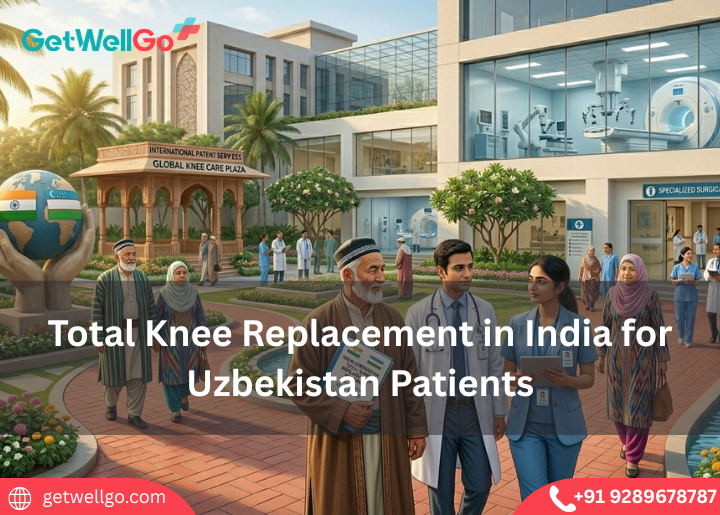
Total Knee Replacement in India for Uzbekistan Patients
Total Knee Replacement in India for Uzbekistan Patients with robotic precision. GetWellGo handles your expert surgeon, Uzbek translator & a fast recovery home.
Patients from Uzbekistan experiencing severe pain, stiffness and problems with mobility in the knee as a result of osteoarthritis, rheumatoid arthritis, previous injuries or other degenerative joint disease may be suitable for Total Knee Replacement in India. There are a number of options available including traditional, minimally invasive and robotic-assisted total knee replacement.
There are a number of hospitals in India offering specialist care for orthopaedic issues, advanced technology for joint replacement and a range of knee implants. International patients can access expert orthopaedic surgeons who can discuss treatment options and provide a personalised treatment plan.
The average price for Total Knee Replacement in India is around $1500-$3350 (UZS 17.95-40.08 million) for a standard total knee replacement. This can vary depending on the hospital, surgeon, brand of implant, type of surgery and severity of the condition. A higher price can be paid for robotic-assisted procedures and high quality implants.
Patients from Uzbekistan should also consider the cost of hospital admission, physio, accommodation, medical visa and follow up appointments. The length of stay will depend on the recovery process and recommendations from the treating surgeon.
When Should I Have a Total Knee Replacement?
The knee joint is a weight bearing joint made up of the femur (thigh bone), tibia (shin bone) and patella (kneecap). The ends of your bones are covered in cartilage to help with smooth movement.
When the cartilage becomes damaged or worn, this can cause pain, inflammation, stiffness and loss of mobility.
A total knee replacement may be recommended when non-surgical treatments are no longer providing adequate relief. Common symptoms include:
Constant knee pain.
Stiffness and limited motion.
Swelling and inflammation.
Difficulties walking or standing for long periods.
Pain when walking up/down stairs.
Difficulties getting out of a chair.
Bow-legs or knock-knees.
Painful knees affecting sleep.
Difficulties carrying out daily activities.
Pain not improving with medication and physiotherapy.
Conditions That May Require a Total Knee Replacement
Osteoarthritis – gradual degradation of the cartilage causing pain, stiffness and damage to the knee joint.
Rheumatoid Arthritis – an autoimmune disease causing inflammation and damage to the joints.
Post Traumatic Arthritis – joint damage and arthritis caused by a previous injury or break.
Severe Knee Injury – complex injuries causing damage to the cartilage.
Avascular Necrosis (AVN) – lack of blood flow to the bone causing damage and collapse.
Other Degenerative Joint Disease – progressive disease causing significant damage to the knee.
The severity of your symptoms, overall medical history, physical examination and imaging (x-rays/MRI) will be taken into consideration by your orthopaedic surgeon to decide if a total knee replacement is suitable.
Types of Knee Replacement
The type of knee replacement recommended will depend on the severity of joint damage, age, bone quality, activity levels and ligament status.
Procedure
What it involves
When it is recommended
Total knee replacement
Replaces the damaged surfaces of the femur and tibia with artificial components. The kneecap may also be resurfaced.
Advanced arthritis affecting multiple compartments of the knee.
Partial knee replacement
Replaces only the damaged compartment while preserving healthy bone and tissues.
Arthritis limited to one compartment with suitable ligaments.
Bilateral knee replacement
Replaces both knee joints during one operation or in separate procedures.
Severe arthritis affecting both knees in selected patients.
Revision knee replacement
Removes and replaces some or all components of an existing knee implant.
Implant loosening, infection, wear or other complications.
Minimally invasive knee replacement
Uses tissue-sparing surgical approaches and smaller incisions where appropriate.
Uses robotic technology and computer-assisted planning to guide bone preparation and implant positioning.
Selected patients based on their anatomy and clinical requirements.
Robotic Assisted Total Knee Replacement
A robotic-assisted total knee replacement uses advanced imaging and computer navigation to help surgeons carry out the procedure.
This can help surgeons with planning the surgery, preparing the bone and placing the implant.
Some hospitals in India, for example, Fortis Memorial Research Institute (Gurugram) and Max Smart Super Speciality Hospital (Saket) use robotic joint replacement technology such as MAKO. Benefits can include:
Personalised pre-operative planning.
Help with implant placement.
Better visualisation.
Help with knee alignment and ligament balancing.
Consistent surgical plan.
However, robotic-assisted surgery is not always required. It will depend on the severity of the condition, anatomy, surgeon experience and requirements.
Knee Implant Options
Choosing the correct implant is an important part of total knee replacement.
Your surgeon will recommend an implant based on your age, bone quality, anatomy, activity levels, medical condition and budget.
Implant type
Description
Cost considerations
Longevity
Standard knee implant
Uses metal femoral and tibial components with a plastic bearing surface.
Usually a more economical option.
Designed for long-term use.
Premium knee implant
Uses selected advanced designs and materials.
May increase the overall package cost.
Depends on implant design and patient factors.
High-flexion knee implant
Designed to accommodate greater knee flexion in selected patients.
May cost more depending on the manufacturer.
Depends on implant quality and usage.
Oxidised zirconium implant
Uses an advanced bearing surface designed to reduce wear.
Generally a higher-cost option.
Designed for long-term durability.
Revision knee implant
Uses specialised components to address bone loss, instability or previous implant failure.
Usually more expensive than primary replacement.
Depends on reconstruction and fixation.
Modern implants can often last around 15-20 years. The longevity will depend on the implant, surgery, weight, activity levels, bone health and other factors.
Cost of Total Knee Replacement in India
The cost of Total Knee Replacement in India will vary depending on the hospital, surgeon, brand of implant, type of surgery, room and severity of condition. Patients from Uzbekistan can choose from a range of options including standard, high quality implants and robotic-assisted procedures.
Type of surgery
Estimated cost (USD)
Approximate cost (UZS)
Partial knee replacement
$1,100–$2,250
UZS 13.16–26.92 million
Standard total knee replacement
$1,500–$3,350
UZS 17.95–40.08 million
Premium implant knee replacement
$2,200–$4,100
UZS 26.32–49.05 million
Robotic-assisted knee replacement
$2,600–$5,600
UZS 31.11–67.00 million
Bilateral knee replacement
$2,600–$6,300
UZS 31.11–75.37 million
Revision knee replacement
$3,500–$7,500
UZS 41.87–89.73 million
What is Usually Included?
A standard package will usually include:
Fees for orthopaedic surgeon and anaesthetist.
Standard knee implant and surgical set.
Operating theatre charge.
Room charge and nursing care.
Standard pre-op investigations.
Standard post-op medication.
Initial physiotherapy.
What is Not Usually Included?
Depending on the hospital and package, extra costs may include:
High quality/Imported implants.
Robotic-assisted surgery.
Extra ICU care.
Blood products and specialist investigations.
Unexpected complications.
Extra hospital stay.
Extra physiotherapy.
Accommodation.
Flights, medical visa, food and local transport.
Long term medication and follow up.
GetWellGo can help patients from Uzbekistan get an accurate indication of their treatment. We can review your medical reports and liaise with suitable hospitals and specialists in India.
Best Hospitals for Total Knee Replacement in India
There are a number of hospitals in India offering specialist orthopaedic care including primary/revision knee replacements, robotic-assisted and complex joint reconstructive surgery. International patients should consider the surgeon experience, implant options, surgery technology, physio and overall cost.
Hospital
Location
Orthopaedic expertise and facilities
Max Smart Super Speciality Hospital
Saket, New Delhi
Robotic-assisted knee replacement, joint reconstruction and advanced joint replacement procedures.
Fortis Memorial Research Institute
Gurugram
Advanced orthopaedics, MAKO robotic technology and complex joint replacement.
BLK-Max Super Speciality Hospital
New Delhi
Primary and revision knee replacement, joint reconstruction and advanced orthopaedic care.
CARE Hospitals
Hyderabad
Total and revision knee replacement, joint reconstruction and orthopaedic services.
Recommended Orthopaedic Surgeons
Max Smart Super Speciality Hospital (Saket)
Dr Ramneek Mahajan is an experienced orthopaedic and joint replacement specialist. He specialises in knee and hip replacements, robotic joint replacement and complex joint reconstructions.
Fortis Memorial Research Institute (Gurugram)
Dr Subhash Jangid is the Principal Director and Unit Head of Orthopaedics. He specialises in knee, hip and shoulder replacement and computer navigated joint reconstruction.
BLK-Max Super Speciality Hospital (New Delhi)
Dr Vivek Mittal is an orthopaedic specialist who works with the Institute for Bone, Joint Replacement, Orthopaedics, Spine and Sports Medicine. He specialises in primary and revision knee and hip replacements.
CARE Hospitals (Hyderabad)
Dr Ashok Raju Gottemukkala is an orthopaedic specialist with experience in joint replacement and reconstruction. He specialises in knee and hip replacement.
How to Choose the Best Total Knee Replacement Surgery Hospital in India
Choosing the right hospital and surgeon is important for receiving the best treatment. Patients from Uzbekistan should consider:
Primary and complex knee replacement experience.
Robotic-assisted experience.
Expertise in treating arthritis, deformity and AVN.
A range of knee implants.
Experience in treating patients with underlying medical conditions.
Physiotherapy available.
Revision surgery available.
Multidisciplinary medical support.
International patient support.
The best hospital and doctor will depend on your diagnosis, medical history, treatment needs and surgeon experience with similar cases. We recommend getting an individual opinion.
Uzbekistan Patient Process
GetWellGo can help you with your medical travel. We can help you understand your treatment options, costs and hospital.
Send Medical Reports
Send your latest knee x-rays and MRI scans, medical history, prescriptions and previous treatments.
Receive Orthopaedic Opinion
We will send your medical reports to a suitable orthopaedic specialist. They will assess your condition and advise if you need medication, physiotherapy, joint preserving treatment or total knee replacement.
Receive Treatment Plan and Cost Indication
You will receive information on what treatment is recommended, which hospital and surgeon would be suitable, implant options and an indication on the cost of your treatment. The hospital will also advise how long you are likely to be in hospital.
Medical Travel Support
GetWellGo can help you with your medical visa invitation letter, appointments, accommodation and transfers.
Pre-Op Investigations
Once you arrive in India you will have a physical examination and any necessary investigations including:
Bloods.
ECG.
Cardiac assessment (if required).
X-rays.
Further imaging (if required).
Anaesthetic review.
Total Knee Replacement Surgery
Your orthopaedic surgeon will carry out the recommended procedure using the chosen surgical technique and anaesthetic. You will be monitored during and after the surgery.
Physiotherapy
Physiotherapy will usually start shortly after your surgery. Your physio will guide you through exercises to help improve your knee movement, build muscle and help you walk safely.
Follow Up and Fit to Fly
Before you return to Uzbekistan, your medical team will check your wound healing, mobility, pain management and risk of blood clots. Your surgeon will advise when you are medically fit to travel long distance.
Recovery
Recovery can take several weeks or months depending on your age, general health, muscle strength, surgical technique and dedication to your physio.
Recovery stage
What patients can expect
First 1–3 days
Pain management, monitoring, assisted mobilisation and initial physiotherapy.
First week
Walking with a walker or crutches and beginning knee movement exercises.
Weeks 2–4
Gradual improvement in mobility, wound healing and everyday activities.
Weeks 4–6
Increased walking distance and strengthening exercises.
Weeks 6–12
Improved independence, knee movement and return to selected daily activities.
After 3 months
Continued strengthening, balance training and functional recovery.
Physiotherapy is an important part of your recovery. It will help build muscle, increase flexibility and regain balance and mobility. Your physio will advise when you can walk, bend your knee, walk up and down stairs and slowly begin to carry out daily activities.
Some patients may require a longer recovery period. This can be because of bilateral or revision knee replacement. Patients with diabetes, sickle cell, heart conditions or other underlying medical conditions may also require extra monitoring and physio.
Risks and Success Rates
Total knee replacement is a well-established orthopaedic procedure. It can significantly reduce pain and improve mobility. However like all major surgery there are risks involved. Possible complications can include:
Infection.
Blood clots and Deep Vein Thrombosis (DVT).
Pulmonary Embolism.
Stiffness.
Persistent pain.
Loosening of implant.
Unstable knee.
Nerve and vessel damage.
Fractures.
Anaesthetic complications.
Many patients will experience significant pain relief and improved mobility. This will depend on the severity of the condition, surgical technique, implant, general health and physio. Patients with diabetes, obesity, heart disease, sickle cell or other underlying conditions may require extra precautions.
Tips for Long Distance Travel
Patients travelling from India to Uzbekistan should plan their return. Major joint replacement can increase the risk of blood clots and sitting for long periods on a flight can increase this risk. Consider:
Getting medical clearance from your surgeon.
Ask how long you should wait before flying long distance.
Request a wheelchair from the airport.
Inform your airline of your mobility requirements.
Request an aisle seat.
Follow your doctor’s advice on blood thinning medication.
Drink plenty of water (if advised).
Do approved exercises for your ankles and legs.
Try not to sit for long periods.
Take your discharge summary, prescriptions and medical reports.
Request help with your luggage and airport transfers.
There is no set time to wait before returning. This will depend on how your wounds have healed, how mobile you are and your risk of blood clots. You must be assessed by your treating surgeon.
Medical Visa and Accommodation
Patients from Uzbekistan will generally require the appropriate medical visa to travel to India. Family members may also require the appropriate attendant visa. Common documents required can include:
Valid Uzbekistani passport.
Invitation/appointment letter from hospital in India.
Latest medical reports.
Passport size photographs.
Completed visa form.
Other documents requested by the Indian authorities.
GetWellGo can help you with your invitation letters from the hospital. Patients may require accommodation close to their chosen hospital. This is so they can attend appointments, physio and follow up. This will depend on the type of procedure, how quickly they recover and surgeon advice.
FAQs
How much does Total Knee Replacement cost in India for patients from Uzbekistan?
A standard total knee replacement will usually cost around $1500-$3350 (UZS 17.95-40.08 million). Robotic assisted, high quality implants and complex procedures can be more expensive.
How long will I be in India for the treatment?
You may be in hospital for around 3-5 days depending on your recovery. International patients may also require extra time for physio and follow up. Overall you may require around 2-3 weeks. Some patients require longer.
How long do the implants last?
Modern implants can often last around 15-20 years. This will depend on the design of the implant, surgical technique, weight, activity and other health factors.
When can I walk after my surgery?
Many patients will be able to walk with assistance within 24hrs. Your surgeon and physio will advise you based on your recovery.
Can I have both knees replaced?
Yes, bilateral knee replacements can be carried out for selected patients. However this can put more strain on your body and you may require intensive physio. Your surgeon will advise if you would be more suited to having both knees done at once or staged.
Is Total Knee Replacement safe for patients with sickle cell?
Selected patients with sickle cell can have a total knee replacement. However careful assessment from orthopaedic surgeons, haematologists and anaesthetists is important to reduce complications.
Is robotic-assisted knee replacement better?
Robotic-assisted can help with personalised planning, bone preparation and implant placement. However it is not always better for all patients. Your surgeon will advise you on the best technique for your condition.
What is the difference between partial and total knee replacement?
Partial knee replacement replaces just the damaged part of your knee. Total knee replacement replaces the damaged joint surfaces. Your surgeon will advise what would be best for you based on your imaging and examination.
Can I have a total knee replacement if I have diabetes or heart disease?
Yes, selected patients with diabetes or heart disease can have a knee replacement after appropriate medical assessment. Extra precautions may be required to reduce surgical risks.
When can I fly back to Uzbekistan?
This will depend on how your wounds have healed, how mobile you are and your risk of blood clots. Some patients may need to wait several weeks before travelling long distance. You must be assessed by your surgeon.
What is the best implant?
There is no one best implant. Your surgeon will take into consideration your age, bone quality, anatomy, activity levels, medical condition and budget.
What medical reports should I send?
Send your latest knee x-rays, MRI scans (if available), medical history, previous treatment details, prescriptions and relevant blood results. If you have any underlying medical conditions please send relevant specialist reports.
Can I have a total knee replacement for AVN?
Yes, selected patients with advanced avascular necrosis of the knee may benefit from a total knee replacement. Earlier stages may require joint preserving procedures depending on how much bone damage there is.
Will I be able to walk up and down stairs?
Many patients will gradually be able to walk up and down stairs. Initially you may require some assistance. Your physio will advise you on how to do this safely.
How long will I be having physio?
Physio will usually start whilst in hospital. Many patients will require several weeks or months to improve knee movement, build muscle and improve mobility.
How do I choose a hospital for total knee replacement surgery in India?
Consider the orthopaedic facilities, surgeon experience, implant options, robotic technology, physio and international patient support. GetWellGo can help you compare suitable hospitals and get specialist opinions.
Other Orthopaedic Treatments Available in India
Patients from Uzbekistan can consider a range of other orthopaedic treatments in India including:
Hip Joint Replacement – for severe arthritis, AVN and significant joint damage.
Spinal Surgery – for selected spinal conditions including spinal stenosis, disc problems and degenerative spine.
Joint Revision – for loose, worn, infected implants.
Arthroscopy – for selected knee injuries, ligament and cartilage conditions.
ACL Reconstruction – for patients with anterior cruciate ligament injuries.
Hip Preservation – for selected patients with early AVN and other hip joint conditions.
Treatment Planning with GetWellGo
If you are experiencing chronic knee pain, severe arthritis, AVN or significant joint damage then considering Total Knee Replacement in India can help you access specialist orthopaedic assessment and treatment. GetWellGo can help patients from Uzbekistan by:
Providing specialist opinions and online consultations.
Comparing suitable hospitals and orthopaedic surgeons.
Understanding what surgical techniques and implants are available.
Providing personalised treatment indications.
Liaising with hospitals for medical visa invitations.
Booking appointments and accommodation.
Airport transfers and local transport.
Post-op support.
Our team can help you understand your treatment options and organise your medical travel from Uzbekistan.
Hip replacement surgery for sickle cell disease: a real case study of an African patient walking with support the same day. See what Nigerians can learn.
Cartilage Regeneration in India: Stop joint wear before it starts! We book your top sports specialist, handle the medical visa & provide a cozy stay to heal.
World Sickle Cell Day 2026: Join the fight for equity. Our Indian medical team helps Nigeria & Kenya patients access curative BMT care, visas & warm stays.
Meniscus Transplant in India: Save your knee joint and live active again! GetWellGo handles your top sports surgeon, medical visa & a cozy recovery home.
Get advanced kyphoplasty in India for spinal fractures. International patients benefit from expert care, modern hospitals, quick recovery, and affordable costs.
Advanced 3D Printed Bone Implants in India fit your body perfectly. GetWellGo handles your custom surgery, flight bookings, and a relaxing place to stay.
Get advanced hip labral tear care in India with skilled orthopedic surgeons, modern techniques, and cost-effective treatment for international patients.
Hip Arthritis in India doesn't have to mean daily pain. GetWellGo handles your complete joint care trip, from finding top specialists to booking your hotel.