Obstetrics and Gynaecology
Posterior Repair Treatment
Posterior Prolapse
A posterior prolapse is a lump in the back wall of the vagina. It is caused by the weakness of the support tissues between the vagina and belly. The lump is called a bulge or prolapse. A posterior prolapse can cause a perception of `something coming down', the feeling of not having an empty belly and the need to press on the back wall of your vagina to fully empty your bowel.
What is a posterior prolapse?
A posterior prolapse is a lump in the back wall of the vagina. It is caused by the weakness of the support tissues between the vagina and belly. The lump is called a bulge or prolapse.
A posterior prolapse can cause a perception of `something coming down', the feeling of not having an empty belly and the need to press on the back wall of your vagina to fully empty your bowel. It can also cause discomfort the person while having sex and difficulty keeping a tampon in.
A posterior prolapse is usually caused post childbirth but sometimes the problem can happen in women who have never been pregnant.
What does the operation involve?
The aim is to tighten the support tissues between your vagina and belly and remove any lump in the vagina.
The patient will have a general anesthetic and be completely asleep.
A small cut is made through the lining of the back side i.e., posterior of the vagina. Stitches are used to shorten the supports to the rectum and the lumped part of the vagina cut away. This repairs any kind of weakness in the tissues.
The wound in the vagina is then stitched up (also called perineal repair). The patient needs to stay in the hospital up to a period of 2 weeks.
The operation usually takes about 30 minutes.
 Free Consultation on WhatsApp
What complications can happen?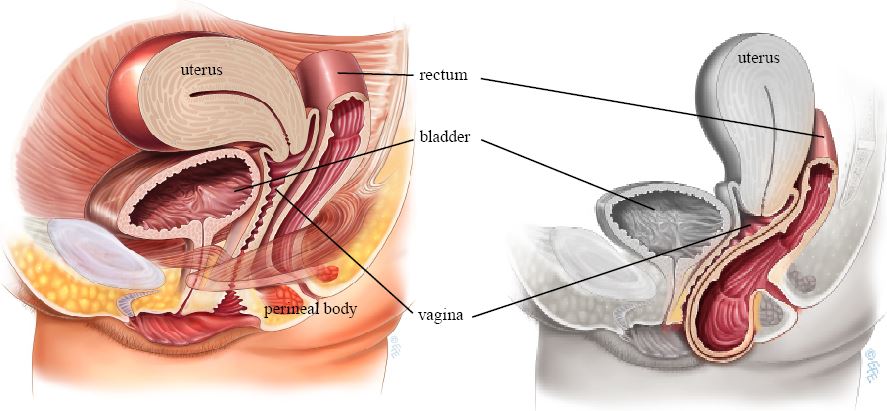
General complications
-
pain
-
feeling or being sick
-
bleeding
-
unsightly scarring
-
blood clots
-
infection of the surgical site (wound)
Specific complications
-
difficulty opening your bowels
-
developing a collection/clotting of blood
-
damage to your belly and surrounding structures
-
difficulty having sex
Before the operation
Get your weight down if you are plumpy (suffering from obesity), stop smoking and if you know that you have problems with your blood pressure, your heart, or your lungs, ask your doctor to check that these are under control.
If you are past the menopause, your vagina may be short of oestrogen. The patient may heal better if she has some hormone replacement treatment (HRT).
You will have the operation explained to you by the nursing staff and will be asked to fill in an operation consent form.
Any tissue that will be removed by the surgeons during the operation is going to be sent for tests to help to plan your further treatment. When the tests are done, what is left of the removed tissues are disposed of.
After the Operation
You will have a drip in an arm vein which would give you extra salt and sugar and water, and sometimes blood, for a day or so required for quick healing.
You may be given oxygen from an oxygen cylinder via a face mask for a few hours if you have had chest problems in the past or you are a smoker or if you are obese. You will have a sanitary pad in place.
The wound would be painful. You will be given painkilling injections or tablets for this, which would behave as temporary anesthesia. PCA is being used in many hospitals (patient-controlled analgesia). By pressing a button on a device, you can inject painkillers into your bloodstream through a very fine plastic tube or drip that goes into one of the veins. A computer attached to the PCA machine controls the amount of painkiller that is released into your veins and prevents any accidental overdose.
A general anesthetic will make your body slow, clumsy and forgetful for about a day. Do not make any important decisions during that time period.
There are stitches in the skin wound across the vagina. The parts of the stitches under the skin will melt away by themselves or will be removed by the doctor. The surface knots of the stitches will appear on the pads after about two weeks. This is expected and the patient should not worry about it.
You should wear pads as dressings. Do not use tampons for six weeks. There will be slight bleeding like at the end of a menstrual cycle. It should almost stop by the time you leave the hospital. There may be a little bleeding again after about 10 days when the knots get free.
Free Consultation on WhatsApp
After – at home
At home, you are likely to feel tired and need rest two or three times a day for a for at least an entire month. You will gradually improve.
After three months, you should be able to return completely to your usual routine and perform daily activities.
You can drive as soon as you can make an emergency stop without any kind of discomfort, generally after 1 week.
If you feel comfortable enough and have no blood loss, you would be able to return to a light job after about 2 months. Leave a very heavy job until 3 months.
What Complications can happen?
As with any operation under general anesthetic, there is a very small risk for complications related to your lungs or your heart.
The tests performed on you before the operation is to make sure that you can have the operation in the safest possible way such that risks for such complications very close to zero.
Most vaginal repairs are without any kind of complication. Problems are being looked for by the medical staff.
Sometimes the bladder is slow to restart it’s functioning.
How soon will I recover?
You should expect a slight discharge of blood (bleeding) from your vagina. Let the doctor know if this becomes heavy. You will usually be able to go home after 1 to 3 days of the operation. Rest for at least 2 weeks and continue to do the exercises that you were shown in the hospital by the nursing staff.
Do not have sex for 2 weeks or at least until any bleeding or discharge has stopped. Do not stand for too long holding anything or lift anything heavy. You can return to work once your doctor has said you are well enough to do so, usually, this takes about a month.
Regular exercise should help you to return to a normal routine as soon as possible.
A posterior repair is a major operation usually recommended after simpler treatments and/or operations have failed. Your belly should be better supported and you should no longer have a lump in your vagina.
Free Consultation on WhatsApp
TREATMENT-RELATED QUESTIONS
GetWellGo will provide you end-to-end guidance and assistance and that will include finding relevant and the best doctors for you in India.
A relationship manager from GetWellGo will be assigned to you who will prepare your case, share with multiple doctors and hospitals and get back to you with a treatment plan, cost of treatment and other useful information. The relationship manager will take care of all details related to your visit and successful return & recovery.
Yes, if you wish GetWellGo can assist you in getting your appointments fixed with multiple doctors and hospitals, which will assist you in getting the second opinion and will help you in cost comparison as well.
Yes, our professional medical team will help you in getting the estimated cost for the treatment. The cost as you may be aware depends on the medical condition, the choice of treatment, the type of room opted for etc. All your medical history and essential treatment details would be analyzed by the team of experts in the hospitals. They will also provide you with the various types of rooms/accommodation packages available and you have to make the selection. Charges are likely to vary by the type of room you take.
You have to check with your health insurance provider for the details.
The price that you get from GetWellGo is directly from the hospital, it is also discounted and lowest possible in most cases. We help you in getting the best price possible.
No, we don't charge patients for any service or convenience fee. All healthcare services GetWellGo provide are free of cost.
.png)